


 Posts
Posts


I know this isn’t a new book - in fact it's 21 years old - but it’s certainly newly in the public eye what with the
upcoming movie (due to be released in theaters August 15), so I thought it was a good
time to revisit it.
I first encountered The Giver when I had to teach it for a
high school class in Japan. I had never heard of it before, and based on the cover I
wasn't too optimistic (yes, I judge books by their covers). An old bearded guy
in black and white and the silhouette of trees at twilight just wasn’t as inspiring as some of the
other books in my to-read-to-teach pile. (Later, I loved finding out the story
of the man on the cover which Lowry explains in her beautiful Newbery acceptance speech here.)
I'm so glad I decided to eventually read (and teach) this book, because The Giver is fantastic.
Dystopia has become a very popular theme in YA lit recently, but Lowry did it in 1993, so I think she got the jump on the trend.
I was able to hear Lois Lowry speak last year at the Brooklyn Book Festival. She said that she didn't deliberately set out to tell a dystopian story, it just developed that way. I think this comes through in the book where the focus is really on memory and emotion and how they inform our individual personalities and give us wisdom.
The book follows a young boy named Jonas who is just turning 12. At his assignment he is given the role of "Receiver" - a role which is only assigned to one person per generation. Jonas is not allowed to talk to anyone else about what his assignment entails, but he discovers that he must receive the collected memories of his society from "the Giver." For the first time he is exposed to things like weather, pain, joy, music, and the idea that there is history beyond what he has seen and experienced. He learns from the Giver that memories of the past were removed from society in order to remove people's desire to choose one thing over the other and to avoid negative emotions and feelings such as jealousy and pain.
The Giver alone holds these memories and uses them to advise the council in times when they are unsure how to act. As Jonas's eyes are gradually opened to all the joy and pain that nobody else in society can experience he starts to realize the wrongness of it all and finds himself ultimately faced with a difficult decision of what to do with his knowledge. I won't spoil it totally. If you haven't read it, go read it.
I loved Jonas's gradual discover of color and the fact that when he finally could see colors he could no longer un-see them or go back to the way he used to see things. It's a great picture of what memories do to us - once we experience something it stays with us forever and shapes how we view the world.
It was very interesting to hear my students' takes on this book. Japanese society highly values conformity. US society values independent action and looks down on conformity. In our class discussions it came out that my students didn't react as strongly against the idea of sameness as I had when I read the book. They saw many aspects of the society in The Giver as positive, though they all agreed that completely taking away freedom of choice was a negative thing. Japan is hardly a dystopia, so it was through provoking to hear how for many sameness = safety and comfort. It made it easier to sympathize with a society which had started out simply trying to protect its citizens from what was negative and painful.
For those who aren't familiar with the book, it takes place in a society where sameness and conformity are valued and it is impolite to point out differences. One's role in life is assigned at the age of 12 by the Elders and is based on where the child's talents seemed to lie. Later in life, their spouses and even children will also be assigned to them.
"The worst part of holding the memories is not the pain. It's the loneliness of it. Memories need to be shared."
The book follows a young boy named Jonas who is just turning 12. At his assignment he is given the role of "Receiver" - a role which is only assigned to one person per generation. Jonas is not allowed to talk to anyone else about what his assignment entails, but he discovers that he must receive the collected memories of his society from "the Giver." For the first time he is exposed to things like weather, pain, joy, music, and the idea that there is history beyond what he has seen and experienced. He learns from the Giver that memories of the past were removed from society in order to remove people's desire to choose one thing over the other and to avoid negative emotions and feelings such as jealousy and pain.
The Giver alone holds these memories and uses them to advise the council in times when they are unsure how to act. As Jonas's eyes are gradually opened to all the joy and pain that nobody else in society can experience he starts to realize the wrongness of it all and finds himself ultimately faced with a difficult decision of what to do with his knowledge. I won't spoil it totally. If you haven't read it, go read it.
I loved Jonas's gradual discover of color and the fact that when he finally could see colors he could no longer un-see them or go back to the way he used to see things. It's a great picture of what memories do to us - once we experience something it stays with us forever and shapes how we view the world.
It was very interesting to hear my students' takes on this book. Japanese society highly values conformity. US society values independent action and looks down on conformity. In our class discussions it came out that my students didn't react as strongly against the idea of sameness as I had when I read the book. They saw many aspects of the society in The Giver as positive, though they all agreed that completely taking away freedom of choice was a negative thing. Japan is hardly a dystopia, so it was through provoking to hear how for many sameness = safety and comfort. It made it easier to sympathize with a society which had started out simply trying to protect its citizens from what was negative and painful.
I am certainly looking forward to the spin the movie will put on it. I have read some interviews with Lois Lowry and she seems pretty chill about the changes, so hopefully even if it's not 100% accurate, it will still be an awesome movie.
 |
| The Monkey Island games: an exemplary series featuring pirate shenanigans of all sorts, not to mention demonic talking skulls, voodoo ladies, and ships of the damned - as any respectable pirate tale ought. |
I also love pirate stories. Treasure Island is one of my favorite books of all time. There really aren’t enough quality pirate books out there (though there are some excellent pirate computer games), so finding a fun, adventurous book which was also about pirates really made my day (thanks husband!)
 Anyway, on to the book. Hook’s Revenge follows the
adventures of young Jocelyn Hook – daughter of the infamous Captain Hook (who she has never met). Jocelyn
takes after her pirate father in that she causes chaos and destruction wherever
she goes, despite being only twelve. In an attempt by her grandfather to
civilize her, she is sent away to finishing school where Miss Eliza Crumb-Biddlecomb does all she can
to whip her into shape. This goes as one might expect, with frustration and disastrous
results for all. That is until Jocelyn is whisked off to Neverland after receiving a message from
her recently dead father (composed before his death, of course. This isn’t that sort of book) setting her the task
of taking revenge on the Neverland crocodile in whose jaws he met his demise.
Anyway, on to the book. Hook’s Revenge follows the
adventures of young Jocelyn Hook – daughter of the infamous Captain Hook (who she has never met). Jocelyn
takes after her pirate father in that she causes chaos and destruction wherever
she goes, despite being only twelve. In an attempt by her grandfather to
civilize her, she is sent away to finishing school where Miss Eliza Crumb-Biddlecomb does all she can
to whip her into shape. This goes as one might expect, with frustration and disastrous
results for all. That is until Jocelyn is whisked off to Neverland after receiving a message from
her recently dead father (composed before his death, of course. This isn’t that sort of book) setting her the task
of taking revenge on the Neverland crocodile in whose jaws he met his demise.I won’t spoil the plot, but it’s a great adventure with some very likable and some very dislikable characters all very well brought to life. The fact that Jocelyn does have moments where she fails or doesn't know what to do next makes her solid and someone you truly want to root for.
The storytelling moves at a good pace with lots of action and just the right amount of humor - perfect for both middle grade and older audiences alike. The narrator is one of the highlights of the book. He (?) is a rather cranky pirate who dislikes children and is only begrudgingly telling us the story because he’s getting older and the story ought to be told to someone. He isn’t ever-present, but he pops back in at regular intervals to remind us that we really are very annoying.
My only dislike of this book was the representation of Peter Pan, strangely enough. He is a very minor character, but he SO annoying. I would much have preferred that he not appear at all rather than have him be represented as a little dictator and such an ass. It is certainly a new take on a classic character, but I think it kind of ruins him for readers who might potentially go on to read Peter Pan for the first time. Of course, Peter was never completely likeable, even in his own book (“Oh the cleverness of me!”) but then again he was an archetype of boyhood, so who can blame him?
I also would have liked to have found that the hateful little girls at the finishing school eventually got their comeuppance, but perhaps that's something for the next book.
Altogether, I thoroughly enjoyed Hook's Revenge, but reading an advanced copy comes with the downside that I’ll have to wait even longer than everyone else for the second in the series.
For more about Heidi Schulz visit her piratey website. To pre-order Hook's Revenge visit Barnes and Noble, or order it to your local independent book store.

New York City has not been the same since terrorists
attacked Times Square with a dirty bomb. Since the attack, the city has been in
a downward spiral of violence and crime where only the rich are safe - behind
heavily guarded doors. Both rich and poor have become addicted to a new type of
drug – virtual reality simulations where they “tap in” to a whole other world,
sometimes for days at a time.
This is the setting of Adam Sternbergh's novel, Shovel Ready, which immediately gripped me. The book is written
in first person from the perspective of Spademan, a garbage man turned hired
killer. Although the voice in which the novel is written annoyed me at first, I eventually found Spademan’s matter-of-fact descriptions and deliberately emotionless
narration served to bring the bleak and hopeless world to more vivid life. I was compelled to read on as the world sprang to life in my imagination. I’m
not sure if the setting was easier for me because I work in New York
City, and thus personally connected with the references to the various locations, or if it was
simply because any city turned to chaos by fear and apathy never seems too far fetched.
Spademan is a quintessential antihero; morally depraved, emotionally
absent, not even driven by a desire for revenge for a past wrong (though it is
hinted that he may develop that desire in the next book). He is not very likable... in fact, none of the
characters in the book are likable, and they all do horrible things, yet still they are compelling. I was reminded of American Hustle in that none of the characters were good guys, but I still wanted the worse ones to lose.
For all of Sternbergh's vivid world-building and engaging plot, the book had its flaws. I found the main issue to be
the lack of character depth. A few of the main characters have back stories, the
rest just exist in the story alone, but there is little to inform motives for
anyone’s actions. Even Spademan can’t explain why he decides to get involved in
the life of one of his targets (the decision that drives the plot). This would
be fine if it was revisited and examined as his relationship with her was built,
but it was never satisfactorily developed. And while history has proved that a
character doesn't need motive to be a fantastically evil villain (look at
Shakespeare’s Iago), the shallow motives for the antagonists’ actions really
left me feeling like a lot was missing. Overall the last quarter of the book
seemed rushed, and this was the section that had the most potential for really
digging deeper (see what I did there?).
This book is not one I would normally have picked up to read.
While I enjoy dystopias and post-apocalyptic settings, I tend to steer away from crime novels, so I am glad that it
was on the Blogging for Books list and I decided to branch out. Despite the novel's drawbacks the plot was compelling and I am looking forward to Sternbergh’s next Spademan novel.
The Girl Who Soared Over Fairyland and Cut the Moon in Two by Catherynne M. Valente
0 comments Posted by Ashley at Wednesday, July 02, 2014
I am back, and that is all, and I will endeavor to be a good
blogger and not forget about my blog again.
I have just finished reading (listening to) The Man
Upstairs, and Other Stories by P.G. Wodehouse. I won’t review it other than to say that the stories
were good in a classic Wodehouse way. If you don’t know what that way is, I
recommend reading at least one Wodehouse in your life. The plots tend to be
similar but that doesn't matter because the brilliance of Wodehouse is in his
descriptions. He can turn a humorous phrase like no other.
 But that’s not what I am reviewing, I am reviewing another
book I recently finished – The Girl who Soared Over Fairyland and Cut the Moon
in Two by Catherynne M. Valente.
But that’s not what I am reviewing, I am reviewing another
book I recently finished – The Girl who Soared Over Fairyland and Cut the Moon
in Two by Catherynne M. Valente.
I have been a fan of Valente ever since my husband bought me
The Girl Who Circumnavigated Fairyland in a Ship of Her Own Making (the titles
are a mouthful) for Valentine’s Day in place of flowers because, well, books
are made of paper, and paper comes from trees, so it’s really basically the
same thing as flowers…. ?
The Fairyland books follow the adventures of a young girl,
September, as she travels through fairyland finding a new adventure each time
she visits. TGWSOFACTMIT (the abbreviation isn't any better, is it?) is the
third in the series and just as with the other two does not disappoint in the
area of fantastical landscapes, vibrant descriptions and creatures of all
sorts. September’s character development is great to see – she does not remain
the same girl we met in book 1 but continues to learn and develop and in this
particular book, even start to become adult (oh no!).
One of the things that first attracted me to Valente’s
writing is the way she almost poetically weaves in statements of truth –
sometimes profound, and sometimes just very well put. I constantly find myself
reading along, and suddenly stopping and going back to reread a section. I
almost wish I had a notebook with me sometimes to write down some of these
bits.
"It's saying no. That's your first hint that something's alive. It says no. That's how you know a baby is starting to turn into a person. They run around saying no all day, throwing their aliveness at everything to see what it'll stick to. You can't say no if you don't have desires and opinions and wants of your own. You wouldn't even want to. No is the heart of thinking."
I do feel that in book 3 some of the characters and landscapes are
thrown in just because Valente liked the idea of them rather than because they
were important to the plot. When more text is spent describing a character than
on their actual involvement in the plot, things become a little unbalanced. I
found myself more than once having to flip back because I couldn't remember how
a scene ended or *why* they met the people made of paper, or how September
ended up in a new place when I’d just got my head around the previous location.
The Fairyland books are Alice in Wonderland-style adventures where the plot is
moved along by each new location or character, but I felt that book three was a
little too fragmented and may have been improved by a little more plot and a
little less description.
All-in-all it was still a great read and I do look forward
to the next book. I’m also currently reading Valente’s short story collection
The Bread We Eat In Dreams and enjoying it very much.
You can buy The Girl Who Soared Over Fairyland and Cut theMoon in Two from Barnes and Noble, or, preferably your local independent bookstore.

The Fourth Bear - Jasper Fforde
Genre: Fantasy, humor
This was the first book I've ever read by Jasper Fforde (whose name, by the way, I always want to pronounce "Ffffffordy"). I had him recommended to me by several people and was told if I liked Terry Pratchett's humor I would probably also like Fforde.
I listened to this as an audiobook read by Simon Vance. He did an excellent job - voices, accents, the whole thing.
What I liked about the books was the world Fforde has created of nursery rhymes and fairy tales mixed in with normal life. It was fun recognizing the characters, puns, and jokes in the book, sometimes snuck in slyly, other times as a long continuing gag. It is a clever idea, though not unique to Fforde - it has been used by Cornelia Funke (another person with an extraneous 'e' on the end of her name), Terry Pratchett and Neil Gaiman to name a few.
The story itself was a bit on the odd side, with individual parts seeming to have only tenuous connections. At times The Fourth Bear seemed like instead of being a story in its own right, it was simply a vehicle to carry all the jokes about nursery rhyme characters and fairy tales that Fforde could think of. Overall it was amusing but not great. Perhaps I would have enjoyed it more if I had read the previous Jack Spratt novels, but I don't really think that would have helped the plot.
Based on The Fourth Bear I haven't been inspired to read much more of Fforde's work. A person with good book taste has, however, assured me that were I to read the Thursday Next novels by Fforde I would enjoy them much more. I am going to give that a try.....soon.

The Ladies of Grace Adieu - Susanna Clarke
Genre: Fantasy
I have to say, I didn't think I would like these short stories. Not because I had heard anything negative about them, but because I had tried Jonathan Strange and Mr.Norrell a few years back and couldn't really get into it. Possibly the reason for that is because I listened to the audio book instead of reading it myself - I found the constant switching to footnotes to be disorienting in an audio-only setting.
The Ladies of Grace Adieu I also listened to, but with fewer footnotes than Jonathan Strange, I found it pleasant as an audio book.
Here are my thoughts on each of the stories:
The Ladies of Grace Adieu - I had thought the title story would dominate the collection a bit more than it did. Not knowing anything about the book I had thought the Ladies would appear throughout the collection. I was a bit disappointed that they did not. After building up their characters so much I found it disappointing that it didn't accumulate to more. The climax felt lacking and parts of the story seemed to be rather less important than it seems they were being built up to be. In the end this was a story about sexism and female revenge. Interesting, but not the best of the lot.
On Lickerish Hill - Another story which took a long time to build up to an anti-climactic ending. This is basically Rumpelstiltskin but instead of a tiny goblin-like man, he's a faerie. This one literally made me say "meh" when it finished. There wasn't enough difference from the original story to make it worth the retelling.
Mrs Mabb - This story was fun but I was disappointed that we never really got to see Mrs.Mabb. Clarke wove in a lot of fairy lore. I like the classic idea that people might lose track of time when under the influence of a fairy and could let the rest of the world pass them by without realizing it. Also the concept that a person could dance themselves to death thinking that they are part of a beautiful ball is very fairy-ish though I can't place where I know it from.
The Duke of Wellington Misplaces His Horse - This story was very short and seemed to lack a point. It had an interesting concept that was not developed very much. The idea that a person's fate could be woven into a tapestry is not new, but I like how Clarke made the Duke able to affect his own fate and intelligent enough to do so.
Mr Simonelli or the Fairy Widower - Probably my favorite of the lot because of all the possibilities it hints at for other stories branching off this one. I particularly like the mouldering glory of the fairy house that is viewed by mortals as a gorgeous palace. I'd like to hear more about Mr.Simonelli.
Tom Brightwind or How the Fairy Bridge Was Built at Thoresby -This story was fun to listen to and moved at a good pace. The scene with all the builders being magically called was very good and really captured my imagination.
Antickes and Frets - I didn't care for this story at all. It was another story that seemed like it was going to be interesting in the beginning but soon lost steam and ended disappointingly.
John Uskglass and the Cumbrian Charcoal Burner - I really enjoyed this story. It's written in classic fairy-tale style with a trio of unfortunate incidents occurring to a poor unsuspecting protagonist (the charcoal burner) who then has to seek help from higher powers to remedy his problems. Each time the problem, and remedy, grow in size until the fairy antagonist must face the charcoal burner and right his wrongs. A good story about the powerless defeating the powerful (with supernatural help).
All in all, I found Clarke's style to be entertaining and often amusing, but in general the stories took rather a while to get to the point. I fear that I still won't have the patience for Jonathan Strange and Mr.Norrell but after these short stories, I am willing to give it another try - this time in text format.
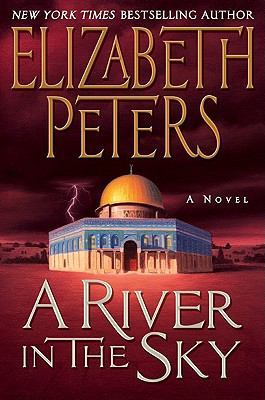
A River in the Sky - Elizabeth Peters
Genre: Mystery
Having been a fan of Elizabeth Peters' Amelia Peabody mysteries for many years, I was pleasantly surprised when I saw she had written a new addition to the series.
Peters has set A River in the Sky in 1910, for fans of the series this means it comes between Guardian of the Horizon and A Falcon at the Portal.
At this time things are heating up politically in the Ottoman Empire and events are in motion that will lead toward the Ottoman-German Alliance in 1914. The Emersons end up smack in the middle of the political turmoil (as is their wont) which this year ends up being Jerusalem rather than Luxor.
Peters has always made her love for history evident in her books, and it has been something I particularly appreciate about this series. However I feel that in this particuar novel she got a bit carried away with wanting the setting to involve pre-WWI politics and the plot consequently became less focused.
I think that in trying to include English secret agents, German spies, underground resistance groups, Turkish militants and corrupt religious leaders too much explanation was necessary before the plot could move forward.
Unlike most other Amelia Peabody books there was not one main mystery which moved the plot along; instead there were mini mysteries that were more like intrigues and unexpected happenings and less like mysteries. The only mystery that continued through until the end was the identity of a particular person and the explanation ended up being very anti-climactic. A lot of the questions that were brought up by the plot either resolved themselves into some ordinary explanation or were explained away quickly at the end of the book.
The main reason I have come to love these books is the characters. One can't help but feel that Peters is writing a bit of herself into Amelia and the fact that she is willing to show when Amelia is being overconfident or ridiculous has always been endearing to me. The books are primarily written in first person (except for the bits from Rameses' journal) and Peters does a brilliant job of conveying a realistically flawed character - who is aware of her flaws - without allowing her to admit it explicitly. Unlike the plot, this aspect of Peters' writing was as good as ever.
Though I still love Peters' writing, I found this book to be mediocre and very very thin on plot.
That said, I still look forward excitedly to see what Elizabeth Peters will write next.
Currently reading:
The Secret Garden - Francis Hodgson Burnett
Unseen Academicals - Terry Pratchett
The Man Who Knew Too Much - G.K. Chesterton
Subscribe to:
Posts (Atom)