


 Posts
Posts


 |
| Map taken from The University of Virginia |
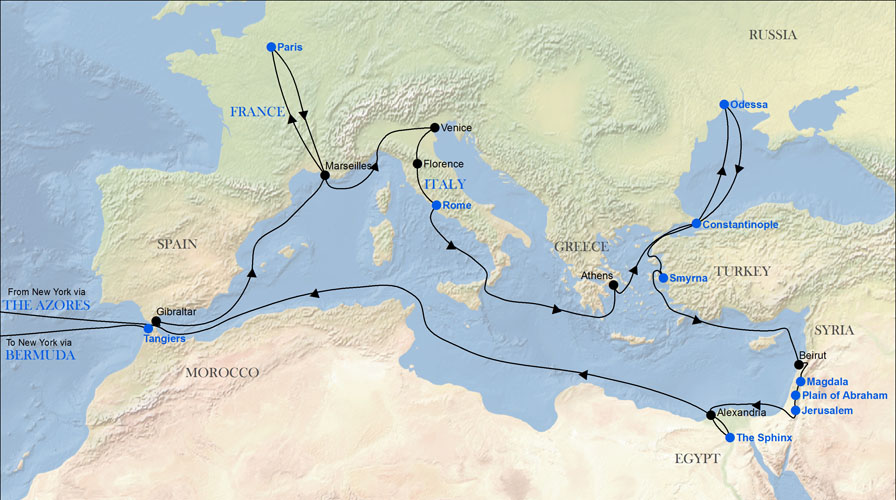
Starting in New York, the cruise traveled across the Atlantic by way of the Azores and into the Mediterranean--including a trip up the Bosphorus and into the Black Sea. The travelers stopped in ports and traveled by land in most of the countries around that sea, taking a lot of time along the way to visit landmarks and take in the sights (including a meeting with Tsar Alexander II). Twain's blisteringly honest and irreverent observations and accounts of these many countries and famous places as they were in the mid-1800s makes for utterly fascinating and often hilarious reading.
It's not always an easy book to read since there isn't a continuous thread of story. I did find that once put down, I could easily not come back to this book for weeks at a time. Each time I picked it back up though, I fell back in love with Twain.
It is important to read this book with a grain of salt. Twain's views are indicative of the prejudices of the day, and he doesn't hesitate to make offensive observations about the "backwardness" of certain people groups and in fact whole countries and compare them to countries considered more civilized (mainly America and England). But in a way I find it refreshing to know they are his honest views, even if some are ones I disagree with. His honesty means that sometimes he drastically changes his view of a place or people group within the same chapter as he gets to learn more about it and he readily admits to this change of view.
"I set down these first thoughts because they are natural--not because they are just or because it is right to set them down. It is easy for book-makers to say 'I thought so and so as I looked upon such and such a scene'--when the truth is, they thought all those fine things afterwards. One's first thought is not likely to be strictly accurate yet it is no crime to think it and none to write it down, subject to modification by later experience."But what makes this so very Twain is that amongst all his complaining about and poking fun at other people and cultures he's not above making fun of himself as well.
I am reminded, now, of one of these complaints of the cookery made by a passenger. The coffee had been steadily growing more and more execrable for the space of three weeks, till at last it had ceased to be coffee altogether and had assumed the nature of mere discolored water — so this person said. He said it was so weak that it was transparent an inch in depth around the edge of the cup. As he approached the table one morning he saw the transparent edge — by means of his extraordinary vision long before he got to his seat. He went back and complained in a high-handed way to Capt. Duncan. He said the coffee was disgraceful. The Captain showed his. It seemed tolerably good. The incipient mutineer was more outraged than ever, then, at what he denounced as the partiality shown the captain’s table over the other tables in the ship. He flourished back and got his cup and set it down triumphantly, and said:The Innocents Abroad is quite a wonderful adventure and the reader gets to see Gibraltar, France, Italy, Greece, Turkey, Russia, Israel, Syria, Egypt, and more as they were 150 years ago. Ships, tropical islands, famous cities, exotic cuisine, art, sculpture, architecture, mountains, rivers, lakes, camels, camping, "the orient," the Holy Land, deserts, mummies, pyramids, really what more could you want?
“Just try that mixture once, Captain Duncan.”
He smelt it — tasted it — smiled benignantly — then said:
“It is inferior — for coffee — but it is pretty fair tea.”
The humbled mutineer smelt it, tasted it, and returned to his seat. He had made an egregious ass of himself before the whole ship. He did it no more. After that he took things as they came. That was me.
I read half of this book, and listened to the other half when it became clear that I'd never end up finishing it if I read it in the traditional way. I listened to it on Librivox, and John Greenman reads it very well indeed.

Blurb
Vince Elgin is an orphan, having lost his mother and his father in a fire when he was young, but beyond that, his life hasn't been much of a fairy tale. With only a senile grandfather he barely knows to call family, Vince was remanded to a group home, where he spun fantastical stories, dreaming of the possibility that his father, whose body was never found, might one day return for him. But it's been a long time since the fire, a long time since Vince has told himself a story worth believing in. That's when a letter arrives, telling Vince his grandfather has passed away. Vince cannot explain it, but he's convinced that if his father is somehow still alive, he'll find him at the funeral. He strikes out for his grandfather's small hometown of Dyerville carrying only one thing with him: his grandfather's journal. The journal tells a story that could not possibly be true, a story of his grandfather's young life involving witches, giants, magical books, and evil spirits. But as Vince reads on and gets closer to Dyerville, fact and fiction begin to intertwine, and Vince finds that his very real adventure may have more in common with his grandfather's than he ever could have known.
 I really enjoyed this book - it reminded me a lot of the film Big Fish in that Vince learns more and more about his grandfather through seemingly fantastical tales, while also learning that there might be more truth in them than he realized.
My thoughts in a few words: Imaginative, suspenseful, frightful, a bit unsatisfying.
Imaginative
Kozlowsky manages to create a vibrant world within the tales that Vince reads. Each tale holds some traditional fairy tale elements while also having new and unexpected twists that keep the readers on their toes. I loved reading about the changing doors within the giant's cave, the creepy creature which guards what Vincent needs, and the dream world where he could stay forever if he wished. The imagery within each of the tales is vibrant and will stay with the reader for a long time after closing the book.
Suspenseful and frightful
Despite the novel being middle grade, it doesn't hold back with the horror. I love when children's books have genuinely creepy bits in like Coraline or The Book of Lost Things (though I suppose you could argue that TBoLT is a novel for adults). Most of The Dyerville Tales are pretty tame, until the last few when the creep factor really gets cranked up. The bit where Vincent has to face The Tall Man actually had me looking up from the book at every noise from the dark hallway outside my bedroom door. Kozlowsky has a gift for creepy characters--The Tall Man, Death, the witch's servants, and eventually the witch herself.
A bit unsatisfying
Spoiler warning. I felt that while the ending of the book was good I wanted something more. There were loose ends that I wanted tied up. I got the feeling that Kozlowsky wanted to make a statement about reality and stories, but I wasn't sure that we ever really got there. I liked that he strings the reader along - are the stories true or not? Are they partly true? In the end, does it matter that a story isn't true if believing in it can inspire us or keep us going? This was good for most of the book and really kept me guessing, but even at the end we aren't given a fulfilling answer. It seems like Kozlowsky is hinting that the stories aren't true but are a way of coping with the real world--then at the very end of the book the indication is strong that the stories are true. But that throws a wrench into the works and opens more questions that are unanswered in the abrupt ending. Is Vince's dad still alive? Were Vince's parents really trying to save him from something the night of the fire? What's the real cause of his grandfather's scar and why was there so much focus on it? What were the numbers on the tree house ladder? There's no indication these answers are being saved for a sequel; throughout the book I was sure these would all be answered by the end, but they weren't and that left me unsatisfied.
Overall this book is definitely worth reading, even if just for the stories within the story.
(Purchase The Dyerville Tales by M.P. Kozlowsky from Indiebound)

I have always found coloring to be a really relaxing activity. When I was a kid my nana used to have a stack of coloring books and a huge basket of crayons next to her couch. I remember flipping through the books, past her neatly colored-within-the-lines pages to whichever blank page took my fancy, and half coloring it before getting bored and moving to another page. She never seemed to mind that her grand kids messed up her coloring books. I wonder what she would have thought of intricate adult-geared books like this one...

 The whimsical worlds the girl travels through really do spark the imagination and are very inviting. They're not only fun to look at, but the detail of the drawings leaves a lot of choices for colorers--these are not pictures where you want to stick with traditional colors for things.
Many of the pictures are spread across two pages making for stunning visuals (though also making it difficult to color into the spine). One of my favorite spreads was of a giant owl flying through the night sky with a house on his back.
I've been using colored pencils in The Time Garden, and they have worked well as long as I keep my sharpener around for the many intricately small sections. The paper is thick enough that markers would probably also work, though I haven't tested that (yet). Traditional crayons are definitely a bad choice.
It's worth noting that though the word "garden" is in the title, the book is not set in a garden and only a few of the pages have garden-ish scenes. So don't choose this one if you're looking primarily for flowers and vines and trees.
All in all this book has been a joy to color so far, and I look forward to many hours filling in the details and bringing the adventurous heroine's magical journey to life.

The Accident Season by Moïra Fowley-Doyle
0 comments Posted by Ashley at Thursday, September 17, 2015 |
| This was perfect plane reading for my trip from the UK to the US. |
The Accident Season is told in first person from the point of view of Cara, a girl whose family seems cursed to suffer from an unnatural amount of physical accidents every October. Each year—led by her mother—Cara, her older sister Alice, and her ex-stepbrother Sam (it’s complicated) hunker down and expect the worst. They do everything they can to minimize the opportunities for accidents to overtake them, yet every October they seem unable to avoid tragedy. This year, Cara begins to notice a strange pattern in her life; every single one of her photographs seem to feature the same childhood friend, but nobody can remember that friend being around or even details about the girl such as what class she was in or what her last name was. As Cara investigates, along with Sam and her best friend Bea, the elusive friend becomes more mysterious and ghostlike. Meanwhile as October draws to a close and the accidents seem to increase, Alice seems to be wrapped up in problems of her own. The layers of secrets around Cara are growing, and she finds it harder and harder to discern reality. Gradually the web of secrets, fears, and lies begins to unravel until all is made clear.
The Accident Season is a novel not only about secrets, but about denial and the processing of truth through fiction. Cara is only able to acknowledge the truth she already knows through her gradually increasing visions of a fantasy where she, Alice, Sam and Bea are each represented by a “changeling.” As Cara begins to realize who the threats are in her life, she sees visions of the changelings facing those enemies, and through that finds power to take action herself. She finds that her ghosts can only be put to rest if she is brave enough to face them.
Fowley-Doyle, I think, leaves it a bit ambiguous just how much of the story is supernatural. But I really like that in a story. I always lean toward it being completely constructed—not because I don’t like the idea of fantasy being real, but because I find it so much more compelling to think about the human mind’s ability to find weird ways to cope with reality. It reminded me a bit of Jonathan Stroud’s The Leap as there is some ambiguity as to whether there is actually a fantastical element to the things that happened, or whether the main character is imagining the fantasy in order to cope with a traumatic reality.
As per my husband's recommendation, the book does have some satisfyingly gothic elements wound throughout its modern-day setting. Parts of the atmosphere reminded me of Doll Bones by Holly Black, but for an older audience. I really enjoyed reading this book and though the action lags a bit toward the middle, the ending resolution is very good.

That was enough to hook me...that and Hardinge's fabulous hat.
So, I bought the book there and asked her to sign it. She drew me a goose. I'm still not sure why, but who says no to the offer of a goose drawing?
I thoroughly enjoyed every page of The Lie Tree. The book opens with an already gothic atmosphere--a dark and stormy day, on a boat, where people are keeping secrets.
Faith has always idolized her father, the naturalist Reverend Erasmus Sunderly, despite his steady chilliness toward her and his preferred treatment of her younger brother. With a quick mind and interest in science, Faith hopes one day to follow in her father's line of work. Unfortunately she is ahead of her time and finds herself trapped by the sexist views of the day that women are meant to be pretty, meek, and simple--not scientists.
When she finds out her father has been keeping dangerous, even life-threatening, secrets, it's up to Faith to try to save his reputation--but in the process she finds herself following in his dark footsteps.
The Lie Tree is beautifully atmospheric with vivid characters whose struggles I found very real. I found myself getting outraged along with Faith at the suffocating unfairness of the day's views of women. Hardinge does a fantastic job of creating a strong female who is able to use both her sharp intellect and society's negative perception of women's intellects to her advantage.
I also loved the mix of the real world setting and the addition of a fantastical magic tree that is never quite explained.
If I had one negative thing to say about the book it was that although the novel had several strong themes, the benightedness of men of the time and the unfair perception of women was a bit heavy handed. I don't think it was misrepresented, but it featured again and again, and I did find myself feeling the same theme could have been conveyed as strongly with a bit less restating.
I would definitely recommend this book to anyone who likes magical realism, gothic settings, and strong female characters. And, when I'm done with the stack of books I'm working through, I will look into more of Hardinge's books.
The Iron Trial by Cassandra Clare and Holly Black
0 comments Posted by Ashley at Monday, August 10, 2015
I bought The Iron Trial last month at the Young Adult Literature Convention where, to my delight, I was able to get it signed by the lovely Cassandra Clare. I was person number 252 of what I think was about 450 people waiting for signings--it turns out she's incredibly popular, and for good reason. Though her published work began with the Mortal Instruments series Clare actually had a fan base built up long before that with her fanfiction writing. Most notably The Very Secret Diaries of the Fellowship of the Rings and the Draco Trilogy (book-length Harry Potter fanfic which she has asked no longer be shared online...though some people might still have copies saved somewhere offline...maybe).
Holly Black also has been writing prolifically and I've loved her writing since reading her first book, Tithe: A Modern Faerie Tale. Finding out these two ladies were going to collaborate on a series made me very happy. (Also, Black is from New Jersey, the best state, so yay.)
The Iron Trial is the first in what is to be a series of five books. The story follows Callum--a young boy with a limp and an affinity for magic--who is called to be tested in the Iron Trial. The Trial is a test for potential mages and whoever passes will enter the Magisterium (a magic school) for formal mage training. There's just one problem. Callum's father was a mage and is dead set against magic after losing Callum's mother in a mage war years earlier. Callum has been brought up to believe that magic is dangerous and mages are heartless, using the students at the Magisterium for their own selfish purposes. Despite trying his best to fail the trial, as his father advised, Callum finds himself apprenticed to a mage and whisked off to the Magisterium against his will. Once there Call finds himself torn between his father's teaching and his own experience with magic while also discovering that his father might be keeping a dark secret about Callum.
 |
| Yay for meeting Cassandra Clare! |
Black and Clare have said that one of their goals in writing this series was to turn common fantasy tropes on their head, and The Iron Trial certainly did make me consider whether or not one should try to avoid tropes or jump in and change them.
A few chapters in, I couldn't help but notice how very Harry Potterish the plot was turning out to be. As a baby Call is the lone survivor of a magical massacre, is left permanently marked by the enemy (his injured leg), finds himself at a school of magic where everything is new and exciting, makes friends with a guy and a girl his age, and gradually finds out more about his own past as the story progresses.
These parallels weren't an accident. Black and Clare couldn't possibly have written this and *not* noticed they were more or less following the plot of Harry Potter. Writers often try to reclaim tropes that have come to be associated with one specific book--after all, J.K. Rowling wasn't the first to come up with the idea of an orphan discovering he was "the chosen one," so it's not fair to give negative marks to any future authors who use that trope. However, it is certainly true that if future authors are going to use it, they must find a way to make it different enough that it doesn't seem like they're copying. In The Iron Trial Clare and Black weren't trying to reclaim the Harry Potter plot so much as start out with a plot readers might expect, and then turn it around into something unexpected. They were reforming readers' expectations of the "chosen one" fantasy trope.
In my opinion, they have been only somewhat successful here. Since the plot followed Harry Potter for much of the book, the first two-thirds or so were fairly predictable. Although there were a couple twists at the end, the prologue had made one of them quite easy to foresee. I appreciate what Clare and Black are doing here, but even with the twists, there wasn't enough of a departure from Harry Potter for the plot to feel original. I realize this is the first of a five book series, so there is plenty of time to take this in a vastly different direction, but in this single first book the plot leans more toward a homage than a reclamation.
Luckily for Black and Clare, they really are fantastic writers, so even with a predictable plot there was plenty else that was unique and I didn't want to put the book down. In the end, tropes or no, The Iron Trial is great fun to read and I do look forward to the next Magisterium book.

I found myself a bit torn about liking or not liking this book. The book's "gospel" format allows it to do away with certain things necessary to most good books--most notably character development and a constant story thread. The lack of these were a bit of a downside because I found the book didn't quite capture my attention consistently. Since each tale was being told after the fact, the feeling of being involved in the action and wondering how each tale might end was missing. While I was reading it, I was interested, but the moment I put the book down I had no real pull to pick it back up again and continue reading. Harris tried to mitigate this by having Loki frequently hint at more to come or to mention that things weren't as good as they seemed, but I didn't find this motivating.
There was little development of any character besides Loki, and while that was likely intentional (he is the star of the book after all) it left me not caring much about any of the characters. Harris did do a good job of fleshing out Loki's character and really giving him a recognizable voice. I usually am drawn to mischievous characters anyway, so Loki's irreverent way of speaking and casual plotting were fun to read. At the same time, Loki's constant references to "yours truly" and "your humble narrator" as well as his pet phrase "so shoot me" really did begin to get on my nerves. I wonder if this wasn't Harris's intention all along as Loki isn't really meant to be completely likable. However, while his casual way of speaking added an irreverent humor to the book, the occasional anachronistic references ("as welcome as a turd in a hot tub") were distracting.
Most interesting to me was that the book contained a half formed idea that Loki initially was not so much a troublemaker but rather just clever and full of energy.. He initially used his wits to the gods' advantage, but slowly the gods refusal to accept him as one of their own drove him towards tricking the gods themselves and eventually becoming one of the driving forces of Ragnarok. I would really have liked to see a more developed plot there rather than sticking to occasional hints in that direction among the tales.
Even without knowing the tales, I got the feeling that this book didn't add a lot to them other than Loki's voice. However, for those unfamiliar with Norse mythology, The Gospel of Loki could be a fun way to learn some of the classic tales without needing to delve into the Prose Edda.