


 Posts


Showing posts with label Librivox. Show all posts
Showing posts with label Librivox. Show all posts
 |
| Map taken from The University of Virginia |
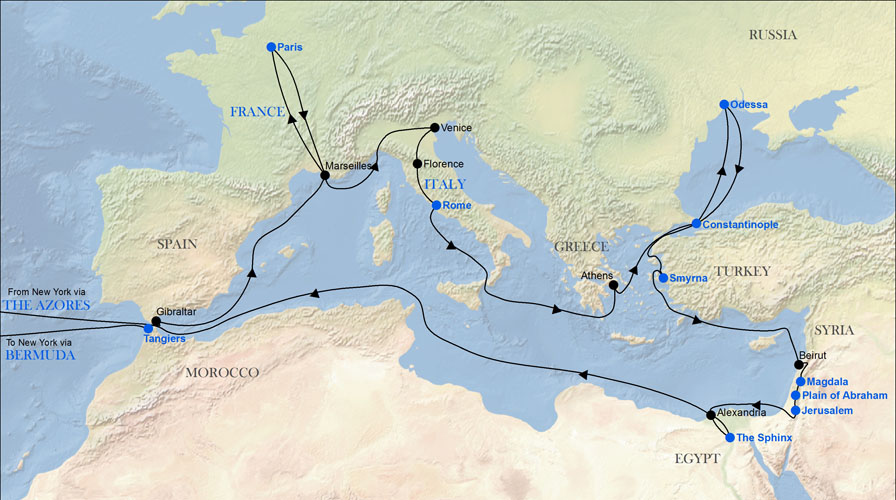
Starting in New York, the cruise traveled across the Atlantic by way of the Azores and into the Mediterranean--including a trip up the Bosphorus and into the Black Sea. The travelers stopped in ports and traveled by land in most of the countries around that sea, taking a lot of time along the way to visit landmarks and take in the sights (including a meeting with Tsar Alexander II). Twain's blisteringly honest and irreverent observations and accounts of these many countries and famous places as they were in the mid-1800s makes for utterly fascinating and often hilarious reading.
It's not always an easy book to read since there isn't a continuous thread of story. I did find that once put down, I could easily not come back to this book for weeks at a time. Each time I picked it back up though, I fell back in love with Twain.
It is important to read this book with a grain of salt. Twain's views are indicative of the prejudices of the day, and he doesn't hesitate to make offensive observations about the "backwardness" of certain people groups and in fact whole countries and compare them to countries considered more civilized (mainly America and England). But in a way I find it refreshing to know they are his honest views, even if some are ones I disagree with. His honesty means that sometimes he drastically changes his view of a place or people group within the same chapter as he gets to learn more about it and he readily admits to this change of view.
"I set down these first thoughts because they are natural--not because they are just or because it is right to set them down. It is easy for book-makers to say 'I thought so and so as I looked upon such and such a scene'--when the truth is, they thought all those fine things afterwards. One's first thought is not likely to be strictly accurate yet it is no crime to think it and none to write it down, subject to modification by later experience."But what makes this so very Twain is that amongst all his complaining about and poking fun at other people and cultures he's not above making fun of himself as well.
I am reminded, now, of one of these complaints of the cookery made by a passenger. The coffee had been steadily growing more and more execrable for the space of three weeks, till at last it had ceased to be coffee altogether and had assumed the nature of mere discolored water — so this person said. He said it was so weak that it was transparent an inch in depth around the edge of the cup. As he approached the table one morning he saw the transparent edge — by means of his extraordinary vision long before he got to his seat. He went back and complained in a high-handed way to Capt. Duncan. He said the coffee was disgraceful. The Captain showed his. It seemed tolerably good. The incipient mutineer was more outraged than ever, then, at what he denounced as the partiality shown the captain’s table over the other tables in the ship. He flourished back and got his cup and set it down triumphantly, and said:The Innocents Abroad is quite a wonderful adventure and the reader gets to see Gibraltar, France, Italy, Greece, Turkey, Russia, Israel, Syria, Egypt, and more as they were 150 years ago. Ships, tropical islands, famous cities, exotic cuisine, art, sculpture, architecture, mountains, rivers, lakes, camels, camping, "the orient," the Holy Land, deserts, mummies, pyramids, really what more could you want?
“Just try that mixture once, Captain Duncan.”
He smelt it — tasted it — smiled benignantly — then said:
“It is inferior — for coffee — but it is pretty fair tea.”
The humbled mutineer smelt it, tasted it, and returned to his seat. He had made an egregious ass of himself before the whole ship. He did it no more. After that he took things as they came. That was me.
I read half of this book, and listened to the other half when it became clear that I'd never end up finishing it if I read it in the traditional way. I listened to it on Librivox, and John Greenman reads it very well indeed.


I am a huge fan of audio books. I remember being a child listening to the read-along cassette tapes from the library (the ones
that would come in a little plastic bag with snaps at the top). I have such fond memories of flipping through Owl at Home and Frog and Toad are Friends with my klunky cassette player whirring along next to me.
As I got older and grew too old for read-along books I sort
of forgot they existed. Except for a gift of The Hobbit on cassette tape when I
was around 12, I barely listened to any for most of my teen years. I still read
ravenously, even progressing to the upstairs “grown up” part of the library
where they kept all the classics. Then one day, as a college student, I
suddenly stumbled upon the library’s secret (so it seemed) stash of hundreds of
audio books on CD. I’d been going to this library my whole life and never knew
about them. It was like finding a hidden treasure. I was suddenly able to read twice as many books as before because I could read while driving (not advisable with print books), walking the dog, cleaning, whatever.
Now, I
never go on a long drive without a book to listen to, and often have one to listen
to during my daily commute as well (currently: The Count of Monte Cristo by
Alexandre Dumas).
 |
| Simon Jones recording The Hitchhiker's Guide to the Galaxy |
Some might say listening to an audio book doesn't count as reading, but I think it really depends on what you are aiming to
get out of your books. Listening to a book opens up some new opportunities. It
means that you can “read” more than you otherwise might be able to, because you
can do it while driving, cleaning, doing laundry, exercising, etc. Though you aren't reading the words, you still expand your imagination, improve your
attention span, learn new things, discover new worlds, and identify with
characters perhaps even more than you might if you were reading the words
silently. Audio books can also encourage people who aren't so great at reading
(dyslexic people for instance) to still “read” and expand their imaginations.
I would never suggest that audio books replace print books.
There is a wealth to be gained from reading words on paper, especially for
young people: learning to recognize
correct spelling (seriously, so many people need this), learning to imagine
character voices and attitudes based on description, learning to sound out
unfamiliar words, improving your
comprehension speed, etc. But I think that audio books should definitely have a
place in everyone’s life alongside normal reading.
My favorites and recommendations:
The Bartimaeus books by Jonathan Stroud, read by Simon Jones – I have never had any other book where I would recommend someone with a choice listen to the audio book INSTEAD OF reading the book, but Simon Jones is just amazing. He IS Bartimaeus. I’m currently listening to the trilogy for the third time.
Anansi Boys by Neil Gaiman, read by Lenny Henry. Though I love Gaiman, I wasn't a big fan of American Gods, and probably by extension wouldn't have been a fan of Anansi Boys had I not heard it brilliantly brought to life by Lenny Henry. I've listened to this one twice, and probably will again.
Winnie-the-Pooh, by A.A. Milne, read by a full cast including Judi Dench, Geoffrey Palmer, and Stephen Fry. This should be required listening for anyone who needs to lower their blood pressure. One if the loveliest books, read by some of Britain's best actors.
Where to get audio books for free
Audio books are really expensive to buy (and rightly so),
however there are a lot of options for audio book lovers who aren't financially
well endowed (poor people,like me).
Library – Seems like
a no-brainer but I think many people don’t realize that most libraries have an
audio book section. You may be surprised if you start looking into your
library’s collection, many often have not only a large CD selection, but more
and more are offering digital collections to their communities and you may be
able to listen online. If you are in the US you can find your local library here - publiclibraries.com
Librivox.org - All
the books on this site are in the public domain, so you won’t find any new
releases, but there is still an impressive range available – all free. All the
readings are done by volunteers - there is no screening process since each
reader is doing it out of the goodness of their heart and their love of books.
This can lead to varying quality in the readings.
I have a love/hate relationship with Librivox. I have
listened to some truly good readings and also some truly truly awful readings.
One woman ended every sentence with rising inflection, as if
it were a question. Another guy read every sentence like it was a radio
announcement. Impossible to listen to and frustrating as well, because they
were ruining good books. Still, I encourage you to check it out, because for
every bad reader there are several good ones. You can download Librivox books
from their website, or from their channel in the iTunes store.
Spotify - Another
free option is Spotify. I haven’t looked to extensively into this but I have
found a few free books there. I am never sitting still long enough to listen on
my computer, however, so I haven’t checked out the quality of what is
available.
Have any other sources for free books? Email me and I’ll
check them out!
Subscribe to:
Posts (Atom)